


FM201 is developed primarily for engineering teams managing drilling operations in high-salinity and ion-rich environments where conventional additives fail to maintain fluid properties. As a product from an experienced polyacrylamide manufacturer, it suits applications demanding reliable shale inhibition and rheology stability. End users benefit from fast-dissolving polyacrylamide powder that enables efficient slurry preparation on-site, minimizing operational delays. Its specialized formulation aligns with requirements of drilling fluid engineers and procurement experts requiring consistent polymer performance for complex wells.
This polyacrylamide polymer ensures excellent resistance to chloride and divalent ions commonly found in brine and seawater-based muds. The white polyacrylamide powder dissolves within 45–60 minutes with a solid content above 89% and controlled particle size distribution (20–40 mesh), providing predictable mixing and hydration profiles. Thermal stability up to 180°C supports demanding geothermal and deep well conditions. Viscosity retention in saline fluids and low residual monomer content further certify the product’s quality as offered by a trusted polyacrylamide supplier. These technical attributes contribute to maintaining drilling fluid integrity and minimizing formation damage.
FM201’s design addresses operational challenges in offshore, salt dome, and deep high-temperature drilling projects, facilitating fluid stability in environments with high salinity and ion contamination. The polyacrylamide polymer supports fluid-loss control and prevents borehole instability by reducing shale dispersion. This results in safer drilling hydraulics and enhanced operational efficiency, notably in systems utilizing recycled or treated water sources. By integrating seamlessly with conventional water-based mud systems, this polymer enhances drilling reliability, reduces corrective chemical interventions, and supports engineering teams focused on cost-efficiency and risk mitigation.
The molecular structure of FM201 polyacrylamide polymer is engineered to resist ion interference, which is crucial for performance in salty environments. As a product offered by a certified polyacrylamide manufacturer, it features consistent particle size and bulk density, facilitating uniform dispersion and hydration kinetics during mixing. The formula’s compatibility with standard mud additives enables seamless integration into existing fluid systems without requiring process modifications. This modular design reduces complexity in formulation adjustments and supports scalable use across diverse drilling platforms, meeting rigorous industrial specifications expected from a professional polyacrylamide supplier.
FM201 exhibits outstanding stability in rheological properties over a broad temperature range, essential for operational reliability in challenging subsurface conditions. The rapid dissolution rate of polyacrylamide powder reduces mud preparation time and enhances turnaround during re-treatment cycles. Users gain performance consistency that lowers non-productive time and operational risks such as stuck pipe or fluid invasion. The product’s ease of storage, handling, and consistent quality control by the producer addresses logistical demands common to large-scale industrial procurement, delivering measurable ROI through improved fluid maintenance and fewer corrective interventions.
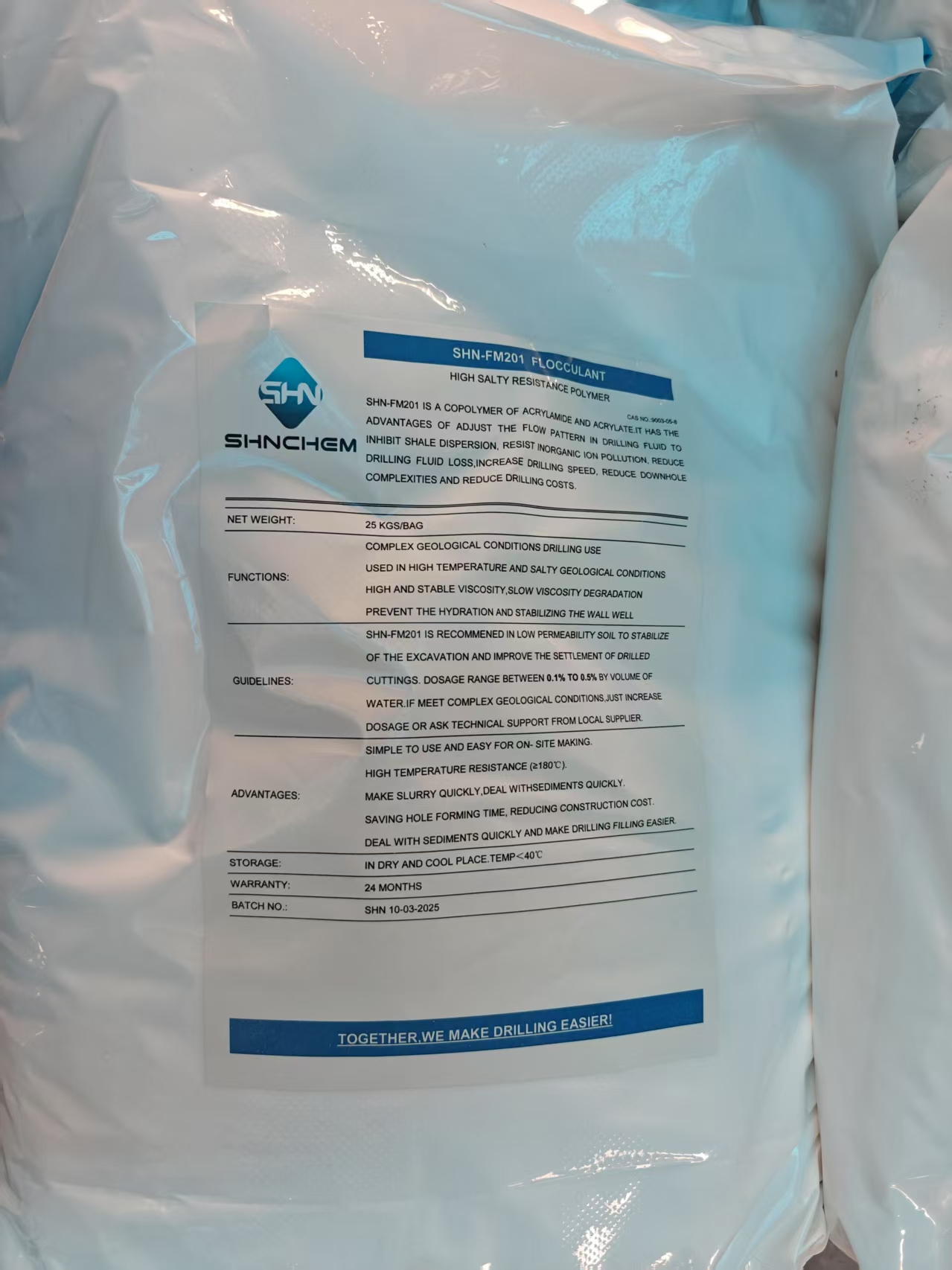
SHN FM201 is a copolymer of acrylamide and acrylate.it has the advantages of adjust the flow pattern in drilling fluid to inhibit shale dispersion, resist inorganic ion pollution, reduce drilling fluid loss,increase drilling speed, reduce downhole complexities and reduce drilling costs.
In offshore drilling, where seawater is frequently used as make-up fluid, FM201 polyacrylamide polymer offers critical advantages by maintaining fluid viscosity and reducing fluid loss despite high chloride ion concentrations. The polymer’s ion tolerance minimizes breakdown of drilling mud properties, supporting wellbore stability and reducing the risk of costly interruptions. Its rapid dissolution and compatibility allow integration into established mud formulations, streamlining onsite mud system management. This ensures drilling engineers can maintain control over fluid rheology and filtration characteristics while adhering to environmental and operational compliance standards.
Salt dome drilling environments impose significant stress on drilling fluid chemistry due to high levels of divalent ions and temperature fluctuations. FM201 is designed to withstand these factors, delivering sustained stability as a polyacrylamide powder optimized for such conditions. It plays a critical role in stabilizing drilling fluid rheology and cuttings transport, reducing shale dispersion and fluid invasion in fractured zones. The polymer’s physical and chemical properties facilitate continuous fluid performance during extended drilling phases, aiding geological assessment operations and drilling process control. Its adoption improves safety margins and operational efficiencies for specialized drilling projects requiring robust polymer solutions.


| Item | Specification |
| Appearance | White Powder or Granule |
| Solid Content% | ≥89% |
| Mesh | 20-40 Mesh |
| Bulk Density | 0.80 – 1.02 g/cm³ |
| Viscosity (0.1% Solution) | Medium to High |
| Viscosity (0.1% Solution in salty condition) | High |
| Residual Monomer | ≤500ppm |
| Insoluble Matter | 0.2% max |
| Dissloving Time | 45-60 Minutes |
| PH Value | 7.0-10.0 |




Use Scenarios
Offshore Salt-Dome and Seawater Make-Up Mud Systems
In offshore drilling where seawater is the primary make-up fluid and salt-dome structures amplify ion contamination, mud systems face rapid viscosity collapse and elevated filtrate risk. FM201 functions as a polymer for saline drilling fluids by retaining rheology in chloride-rich environments and helping control fluid loss to reduce invasion into permeable or fractured intervals. As a near sea projects drilling use polymer, it supports consistent mud properties despite frequent density and salinity adjustments driven by operational changes. Integration is straightforward: the product is hydrated in the mixing hopper within 45–60 minutes, then circulated to condition the system while monitoring funnel viscosity, API/HTHP filtrate, and shale inhibition indicators. Working with a qualified High salty resistance polymer supplier further supports batch-to-batch predictability for offshore inventory planning.
Deep High-Temperature Wells Using Brackish or Recycled Water
In deep wells where bottom-hole temperatures approach the polymer’s ≥180°C tolerance, operators often rely on brackish sources or recycled fluids that introduce inorganic ions and variable pH. FM201 serves as a High salty resistance polymer to stabilize viscosity and reduce sensitivity to ion pollution, supporting steady hydraulics and improved wellbore stability across long circulating times. Where water sourcing intersects with polymer for high salinity groundwater conditions, its low insoluble matter and controlled residual monomer profile helps meet procurement and handling requirements while maintaining performance. In workflow terms, FM201 is added during initial mud-up or as a corrective treatment after contamination; it fits routine QA/QC practices by tracking rheology, filtrate, and solids control efficiency. This approach improves drilling efficiency while keeping the mud program aligned with operational reliability targets.


